- Buying property in Istanbul
- Areas of the European part of Istanbul
- Buying property and houses in Sariyer
- Buying property and houses in Besiktas
- Buying property and houses in Kagithane
- Buying property and houses in Bakirkoy
- Buying property and houses in Sisli (Şişli)
- Buying property and houses in Buyukcekmece
- Buying property and houses in Zeytinburnu
- Properties for Sale in Beyoglu Istanbul
- Buying property and houses in Bahçelievler
- Properties for Sale in kucukcekmece Istanbul
- Buying property and houses in Beylikduzu
- Buying property and houses in Bagcilar
- Buying property and houses in AyupSultan
- Buying property and houses in basaksehir
- Buying a property and house in Avcilar
- Buying property and houses in Esenyurt
- Buying property and houses in Arnavutkoy
- Buying property and houses in Sultangazi
- Buying property and houses in Gungoren
- Buying property and houses in Bayrampasa
- Buying property and houses in Gaziosmanpasa
- Buying property and houses in Esenler
- Buying property and houses in Fatih
- Buying property and houses in Çatalca
- Buying property and houses in Silivri
- Areas of the Asian side of Istanbul
- Buying property and houses in umraniye
- Buying property and houses in Atasehir
- Buying property and houses in Beykoz
- Buying property and houses in Uskudar
- Buying property and houses in Kadikoy
- Buying property and houses in Maltepe
- Buying property and houses in Tuzla
- Buying property and houses in Kartal
- Buying property and houses in Pendik
- Buying property and houses in Sultanbeyli
- Buying property and houses in cekmekoy
- Buying property and houses in sancaktepe
- Buying property and houses in sile
- Buying property and houses in Adalar
- Areas of the European part of Istanbul
- Buying Property in Turkey with Installments
- Buying a residential apartment (normal) in Türkiye
- Buying a residential complex (city) in Türkiye
- Buying office property in Türkiye
- Buying commercial property in Türkiye
- Buying a villa in Türkiye


Obtaining a student residence permit in Turkey
Student residence permit without attending classes

ادامه تحصیل پزشکان
اشتغال پزشکان ایرانی در ترکیه

بهترین دانشگاه های ترکیه
دریافت بورسیه تحصیلی ترکیه

کارآموزی دانشجویان در ترکیه
فرصتهای کاری برای دانشجویان خارجی

Admission Requirements for Turkish Universities (Documents, Exams, Acceptance Process)
Admission to Turkish universities varies depending on the type of institution (public or private), level of study (associate, bachelor’s, etc.), and chosen program. Unlike many European countries, Turkey offers more diverse pathways to enter universities, which increases the chances of acceptance for international students, including Iranians.
Admission to Public Universities in Turkey(Devlet Üniversiteleri)
Public universities in Turkey are usually more competitive and have lower tuition fees. To gain admission, typically one of the following is required:
- Taking the YÖS exam (entrance exam for Turkish universities)
- Having a valid SAT score (in some universities)
- Review of academic records (high school diploma and transcripts)
📌 Important Note: In highly demanded fields such as medicine, dentistry, and pharmacy, competition is very intense. Achieving a good score in the YÖS or SAT exam significantly increases the chance of acceptance.
Admission to Private Universities in Turkey(Vakif Üniversiteleri)
Private universities generally have an easier admission process, and in many cases:
- No entrance exam is required
- Admission is based on academic records
- Faster acceptance is possible
For this reason, many international students choose private universities to reduce risk and speed up the process.
Can You Study in Turkey Without an Entrance Exam?
Yes, in many private universities in Turkey, admission is possible without an entrance exam. These universities usually have a simpler admission process compared to public universities and issue acceptance mainly based on academic documents. In this pathway:
- Providing a high school diploma and transcripts is sufficient
- Minimum GPA requirements are generally low and accessible
- The admission process is completed in a short time
In practice, due to the high admission capacity in private universities, many applicants succeed in gaining admission without serious competition.
📌 This pathway is one of the most common methods to obtain a student residence permit in Turkey in the shortest time.
Can You Get Admission Without a Language Certificate?
In many Turkish universities, having a language certificate (English or Turkish) is not mandatory for international students. Admission is possible without it. If the student does not have a certificate:
- They enter a language preparatory program (Hazırlık), usually lasting one year.
- After passing the university’s language exam, they can start their main program.
- If they do not pass, they are allowed to repeat the preparatory program for a second year.
📌 This is one of the major advantages of studying in Turkey compared to many European countries.

Can You Apply to University Only to Obtain Residence?
In recent years, the student residence permit in Turkey has become one of the fastest and most affordable ways to obtain legal residency in the country. For this reason, some individuals enroll in universities not primarily to study, but simply to secure legal residence in Turkey. In this pathway:
- Enrollment is usually done through private universities with easier conditions.
- Participation in language preparatory courses (Hazırlık) is possible.
- Attendance requirements in some cases are more flexible, with options for online or distance learning.
📌 Important Note: Rules regarding class attendance, academic progress, and residence permit renewal may vary by university. Therefore, choosing the right institution and pathway is extremely important.
If your goal is only to obtain student residence rather than study, it is strongly recommended to carefully review university conditions, attendance rules, and potential risks before applying.
Required Documents for Admission to Turkish Universities
To receive admission from Turkish universities, certain documents are mandatory. These may vary depending on the university and level of study (associate, bachelor’s, etc.), but generally include :
- Valid passport
- Latest educational certificate with official translation and notarization (if translated in Iran, must be approved by the Ministry of Foreign Affairs and the Judiciary)
- Translated and notarized transcripts
- Recent biometric photo
- Language certificate (if available): English: IELTS or TOEFL /Turkish: TÖMER
- International exam scores (required by some universities) : Bachelor’s: YÖS or SAT / Master’s/PhD: GRE, GMAT, or ALE
Additional documents may also be requested, such as :
- Academic resume (for higher levels)
- Statement of Purpose (SOP)
- Recommendation letters
📌 Important Note: All documents must be officially translated and notarized in Turkey. Proper preparation of documents plays a crucial role in speeding up the admission process and avoiding delays.
Process to Obtain a Student Residence Permit in Turkey (Step‑by‑Step)
- Choose your program and university Select your field of study and institution based on your goals, budget, and admission requirements. This choice directly impacts your academic path and future career.
- Receive admission from the university Submit the required documents and apply for admission. In private universities, this step is usually faster.
- Initial registration and tuition payment After admission is issued, complete your initial registration and pay tuition fees. The university then provides an official acceptance letter confirming your student status.
- Obtain a student visa (for certain nationalities) Applicants from countries without visa‑free entry to Turkey (such as Afghanistan, Bangladesh, Nigeria, etc.) must apply for a student visa at the Turkish embassy or consulate in their home country using the acceptance letter. 📌 The visa process may take several weeks depending on the country of origin, so it is recommended to start early.
- Enter Turkey Students requiring a visa must enter Turkey after receiving it. Those with visa‑free access (such as Iranians) can enter directly and complete registration and residence procedures inside Turkey, making the process faster and simpler.
- Complete full registration at the university Upon arrival, finalize your registration in person and submit original documents.
- Apply for student residence (İkamet) Submit your application to the Turkish Immigration Office. The residence permit is usually issued for one year and can be renewed until graduation.
- Receive your student residence card After approval, the Immigration Office issues the student residence card and sends it to your registered address (home or dormitory).
📌 Important Note : Following the correct order of steps, choosing the right university, learning basic Turkish, and understanding both university rules and immigration regulations greatly influence the speed and success of obtaining a student residence permit. For this reason, many applicants prefer to work with a professional consultant who provides accurate guidance and step‑by‑step support, minimizing risks and ensuring a smoother process.
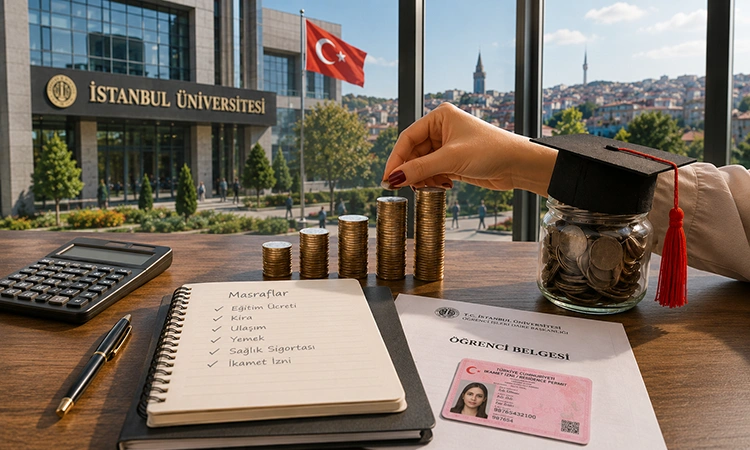
Tuition and Living Costs for Students in Turkey (2026)
The cost of studying and living in Turkey is one of the most important factors for international students when making decisions. These expenses vary depending on the city, type of university, and lifestyle, but overall, Turkey is considered a more affordable option compared to many European and American countries. Below, we review tuition fees and student living costs in detail.
University Tuition Fees in Turkey
Tuition fees in Turkish universities depend on several factors, including the type of university (public or private), level of study, chosen program, and language of instruction (Turkish or English). Despite these variations, Turkey remains one of the most cost‑effective destinations for international students.
- Public universities usually have lower tuition fees, ranging between $300 and $1,500 per year in many fields. However, popular programs such as medicine, dentistry, and pharmacy are more expensive, with tuition reaching several thousand dollars annually.
- Private universities charge higher fees depending on their reputation and program. On average, international students pay between $1,500 and $20,000 per year, with medical programs often costing more.
- Many private universities in Turkey offer scholarships and discounts for international students, which means the final amount paid is often lower than the official tuition announced.
📌 Important Note: The above costs cover tuition only. Students must also consider living expenses, accommodation, health insurance, transportation, and daily needs in their financial planning.
Student Living Costs in Turkey
Living costs for students in Turkey depend on lifestyle, city of study, and type of accommodation. Monthly expenses typically include housing, food, transportation, internet, and personal costs.
- Students living in public or private dormitories usually pay less.
- Renting an apartment, especially in major cities like Istanbul, Ankara, and Izmir, is more expensive.
- In addition to housing, students should budget for groceries, utilities, transportation, and other daily expenses.
One of the advantages of studying in Turkey is that students benefit from special discounts on many public services. Using a student card reduces the cost of public transportation, access to cultural centers, and even some educational services, helping students manage their budget more effectively.
Overall, student living costs in Turkey are more affordable compared to many European and North American countries. With proper financial planning, students can enjoy a relatively cost‑effective student life. However, the final amount depends largely on the city of residence and personal lifestyle.
Costs of Obtaining a Student Residence Permit in Turkey
After registering at a university and entering Turkey, international students must apply for a student residence permit to stay legally during their studies. These costs are usually a small portion of the overall budget compared to tuition and living expenses. The main costs in 2026 include :
- Residence card fee (İkamet Kart Bedeli): 964 TRY
- One‑year health insurance (Sağlık Sigortası): Mandatory, with costs varying by age and insurance provider
- Translation and notarization of academic documents and transcripts: Around 6,000–6,500 TRY in 2026
- Notarization of rental contracts for students who rent apartments instead of living in dormitories
Full Breakdown of Student Residence Costs in Turkey (2026)
The table below summarizes all costs related to obtaining a student residence permit. Please note that amounts are averages and may vary depending on personal circumstances, lifestyle, and university choice.
Minimum Budget Required for a Student in Turkey
Student living expenses in Turkey are not limited to rent or food; they include a set of essential costs such as accommodation, transportation, health insurance, internet, and daily expenses. An important point is that university tuition fees are usually paid separately at the time of enrollment and are not included in the monthly budget. Therefore, students need to plan a clear financial strategy for their living costs in addition to tuition fees.
Students who stay in public or student dormitories and choose a more economical lifestyle can usually manage their studies with a lower budget. In contrast, renting a private apartment and relying more on city facilities significantly increases expenses. On average in 2026
- Dormitory residents : around $65–700 per month
- Apartment renters : around $350–1500 per month
Advantages and Disadvantages of Student Residence in Turkey
Student residence in Turkey is one of the most common temporary residence options for foreign nationals, allowing them to legally live in the country during their studies. This type of residence not only provides the opportunity to continue education at Turkish universities but also comes with specific benefits and limitations that students should be aware of when choosing their path.
Advantages:
- Legal residence in Turkey until the end of studies
- Opportunity to study in Turkish or English
- Access to educational and healthcare services
- Ability to open a bank account, obtain a SIM card, and rent housing
- Student discounts for transportation and other services
- International study environment with broader career and academic opportunities after graduation
- Possibility of converting student residence into Turkish citizenship
Limitations (Disadvantages) :
- Validity of residence depends on continuing education; dropping out, withdrawal, or expulsion leads to cancellation of the permit
- Student residence alone does not directly grant permanent residence or citizenship
- Employment in Turkey requires compliance with student work regulations
In general, student residence in Turkey is a suitable option for those who intend to study at Turkish universities and want to live legally in the country during their studies. Awareness of the advantages and limitations helps students plan realistically for their academic and residency future.
Iranian-Approved Universities in Turkey
Some universities in Turkey are included in the list of institutions approved by Iran’s Ministry of Science, Research and Technology (for general fields) and the Ministry of Health (for medical fields). Studying at these universities is particularly important for students who plan to return to Iran for further education, employment, or professional activities.
If a student graduates from a university approved by Iran, their degree is officially recognized in Iran and usually does not require complex equivalency procedures. This is especially valuable for those intending to take postgraduate entrance exams, pursue government employment, or engage in specialized professions.
Key Points about Iranian-Approved Universities:
- The list of approved universities is updated annually by Iran’s Ministry of Science and Ministry of Health.
- The latest list can be found on the official website of the Turkish Council of Higher Education (YÖK).
- Approval status may change from year to year.
- Recognition can vary depending on the academic level and field of study.
- Checking this status before applying to a university is essential.
Can Students Work with a Residence Permit in Turkey?
One of the most common questions among international students in Turkey is whether they are allowed to work while holding a student residence permit. According to Turkish regulations, foreign students can work under specific conditions, but employment is subject to obtaining a work permit.
In general, a student residence permit alone does not grant the right to work. Foreign students studying in Turkey may work part-time if they receive a valid work permit.
- Undergraduate and Associate Degree Students: Work is usually limited to 20–24 hours per week, and completing the first year of study is required before applying for a work permit.
- Master’s and PhD Students: Restrictions are less strict, and the first-year requirement does not apply. However, employment is still considered part-time and subject to regulations.
Overall, while student residence permits provide legal status for studying, students must obtain a separate work permit to engage in employment.
Converting Student Residence to Work Residence in Turkey
Many international students wish to remain in Turkey after graduation and enter the local job market. In such cases, it is possible to convert a student residence permit into a work residence permit by finding an employer and obtaining a work permit.
In practice, graduates can apply for job opportunities related to their field of study and expertise. If a Turkish employer is willing to hire the graduate and meets the legal requirements, the process of obtaining a work permit begins. Once the work permit is issued, the individual’s residence status changes according to the regulations governing foreign employment.
Converting a student residence into a work residence is one of the most common pathways for continuing life in Turkey after completing studies. For this reason, many students start preparing early by learning Turkish, participating in internships, and building professional connections to increase their chances of entering the Turkish job market.
Those who plan to work in Turkey after graduation are advised to invest not only in academic success but also in developing professional skills and understanding the local labor market. This preparation makes the transition from student residence to work residence, and obtaining the çalışma izni (work permit), much easier.
For more details about the application process, requirements, and costs of obtaining a work permit, you can refer to the Comprehensive Guide to Work Residence in Turkey.
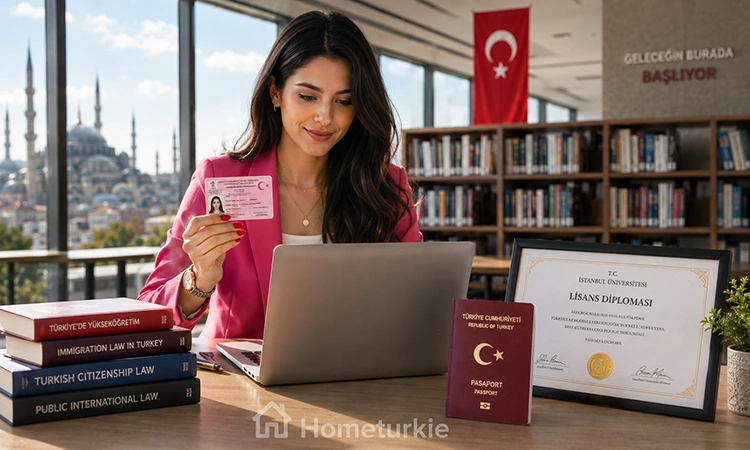
Does a Student Residence Permit Lead to Turkish Citizenship?
Many applicants for studying in Turkey wonder whether obtaining a student residence permit can eventually lead to Turkish citizenship. The answer is that a student residence permit alone is not a direct pathway to citizenship or a Turkish passport, but it can be the starting point for long-term residence in the country.
After graduation, many international students convert their student residence into a work residence by finding employment and obtaining a work permit. In this case, they can legally continue living and working in Turkey, and if they meet the necessary requirements, they may apply for citizenship in the future.
Beyond employment, some graduates pursue other legal routes such as property purchase in Turkey, investment, company registration, or marriage to a Turkish citizen. Each of these pathways has its own conditions, benefits, and requirements, and can provide the foundation for long-term residence.
Therefore, those who aim for permanent migration and citizenship should use their student years to learn Turkish, build professional skills, gain work experience, and plan for a transition to work or other residence types. In many cases, student residence is the first step toward migration to Turkey, but citizenship is usually achieved through subsequent stages after changing the type of residence.
Renewal of Student Residence in Turkey
A student residence permit in Turkey remains valid as long as the student continues their studies at a recognized educational institution. Foreign students must apply for renewal before their residence card expires to maintain their legal status.
The renewal process typically involves updating academic information, providing proof of continued enrollment, valid health insurance, and other documents required by the Turkish immigration office. Since regulations and required documents may change over time, students are advised to check the requirements a few weeks before their permit expires.
A key point in the renewal process is maintaining active student status. If a student suspends or discontinues their studies, their renewal application may face difficulties. It is strongly recommended not to postpone administrative steps until the last days and to prepare the necessary documents in advance.
Timely renewal prevents potential issues with academic, banking, or residency matters and ensures uninterrupted study and life in Turkey. Overall, the renewal process is relatively straightforward, and as long as studies continue and documents are complete, students can legally reside in Turkey until the end of their academic program.
Reasons for Rejection of Student Residence in Turkey
Although the process of obtaining a student residence permit in Turkey is relatively straightforward compared to other types of residence, applications may still be rejected if there are errors or missing documents. Understanding the most common reasons for rejection helps students avoid potential problems.
One of the main reasons for rejection is incomplete documentation or incorrect information in the application. Any inconsistency between submitted documents and registered information can cause delays or denial.
Other common reasons include:
- Lack of valid health insurance
- Submission of incomplete academic documents
- Incorrect registration of residential address
- Failure to prove continued enrollment at a university
HomeTurkie Services for Studying in Turkey
The HomeTurkie team specializes in:
- University admission in Turkey
- Academic and program selection consulting
- University registration support
- Assistance with student residence applications
We guide you through every step to ensure you study at the best university and program while successfully obtaining your student residence permit. Studying in Turkey is an excellent opportunity to build a secure academic and professional future. With the right choice of university and residence pathway, you can benefit from high-quality education and life in a dynamic country.